
“The great benefit of slowing down is reclaiming the time and tranquility to make meaningful connections—with people, with culture, with work, with nature, with our own bodies and minds.” -Carl Honore

The concept of slow living or intentional living has been around for decades, but it’s having a moment in the spotlight now, as things like AI and our ever-present phones and pinging notifications make life seem even more hectic and fast-paced than ever. At inGamba, we’ve long embraced the idea of slow living… though, of course, we believe slow living is best paired with riding at whatever damn speed suits you at the moment, from screaming down a mountain descent to leisurely pedaling along a white gravel road and admiring the view. But if you’re new to the concept of slow living, it’s an idea worth exploring, whether you’re joining us for a week or you’re simply trying to make more space in your day to day life.
The father of the slow living movement, Carl Honore, author of In Praise of Slowness: Challenging the Cult of Speed, perhaps said it best:
“By slowing down at the right moments, people find that they do everything better: They eat better; they make love better; they exercise better; they work better; they live better.”

When author, noted sommelier and avid cyclist Aldo Sohm was talking with us for an upcoming episode of Cycling Conversations with inGamba, he recalled riding in Tuscany, and how the ride from vineyard to vineyard taught him something about the climate and the grapes that a drive simply could not.
“When you cycle between the vineyards, you feel the air is getting cooler from place to place as you climb,” he says. “In a car, you don’t realize, because it’s a very curvy road [so you don’t notice you’re climbing] and you don’t feel the temperature because your AC is probably on and you’re distracted by the music. In cycling, everything is slowed down.”
While riding at a slower pace and taking notice of your surroundings is an obvious example of slow or intentional living, even a fast ride can be done intentionally, arguably slowly. Rather than rushing out the door, taking the extra minute or two to choose your favorite socks, sip that espresso to start the ride with a pleasant little buzz, and simply slow down your movements so that when you get on the bike, it feels like an exhale, rather than a panting race to get moving.
If you’ve joined us on a trip in the past, you know that this easy start to the ride is part of our day—yes, we start on time, and we ride at the pace the group chooses to ride at, sometimes fast and sometimes meandering, but nothing feels rushed. Every moment feels like one to savor: Your helmet and shoes, plus any cold or wet weather gear, is waiting for you in your designated locker at the service course at Borgolecchi. Your clean kit has been through the laundry and is folded neatly on your bed, waiting for you. And of course, your freshly cleaned bike with a perfectly lubed drivetrain, optimally pumped tires, and charged cycling computer awaits you outside. Can you bring that same feeling to your garage and closet at home?
For cyclists, Honore makes the concept even simpler to understand. He wrote: “Shifting the mind into lower gear can bring better health, inner calm, enhanced concentration and the ability to think more creatively.” This mindset tool is a perfect one for a cyclist to use, since we can visualize the downshift perfectly. When you are feeling a moment of overwhelm—the phone is pinging incessantly, you’re in the middle of a major project at work, or you’re simply feeling like there aren’t enough hours in the day—picture the drivetrain of your perfectly tuned Pinarello Dogma F. Now, picture shifting into an easier gear, the chain clicking up in the cassette. It’s a small meditative moment, but can be enough to interrupt your stressed state and slow you down so you’re able to think clearer and focus on what really matters in the moment.
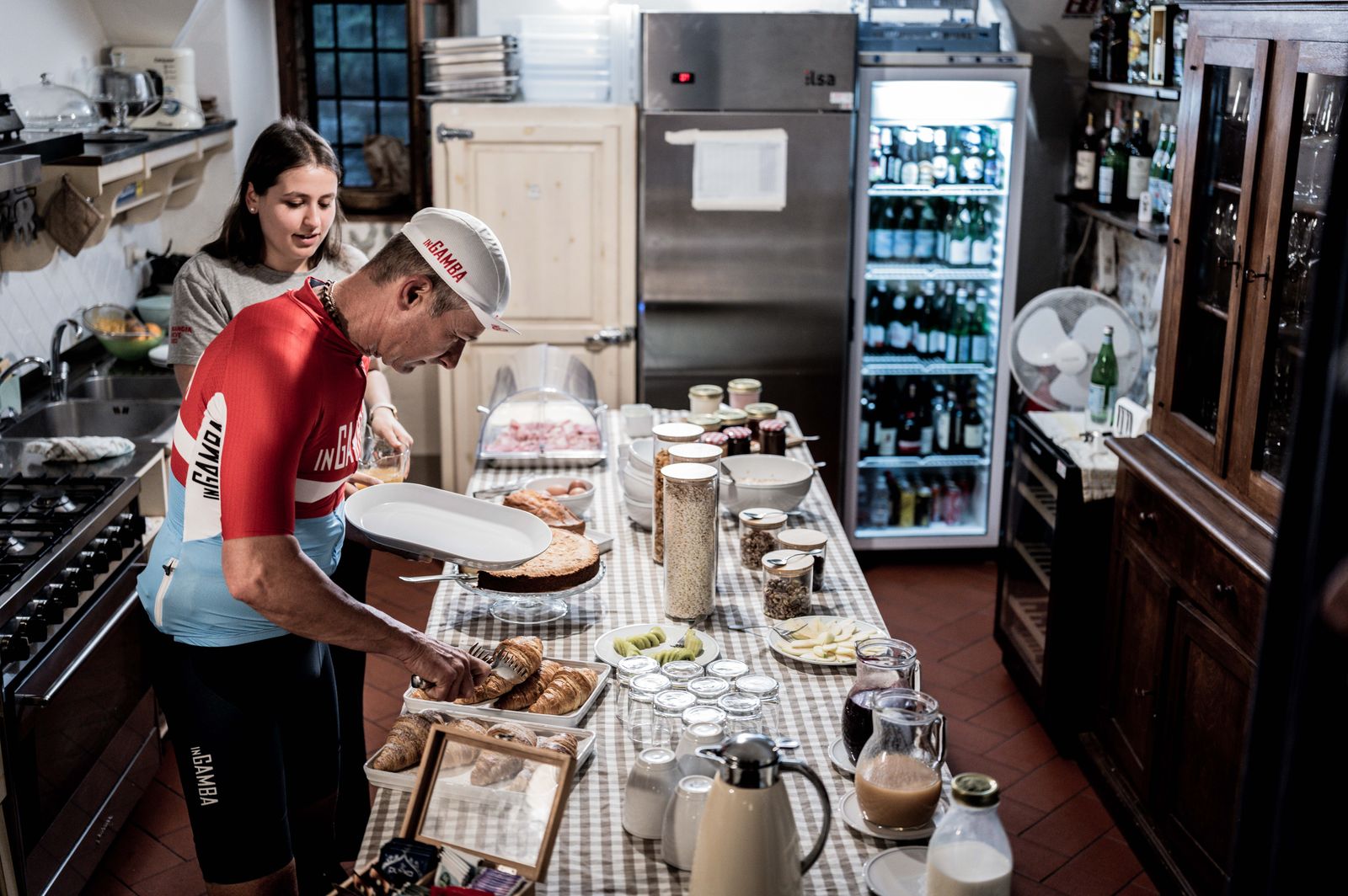
Mealtime is arguably the best time to practice slow living: Most of us know that dinner is the meal that should be respected. We’re done with the workday, and dinner is the chance to sit at the table with family or friends, sipping a glass of wine, dipping a piece of bread in fresh olive oil, savoring each bite of your main course—a rare steak, a perfectly seared scallop or a simple pasta dish. Even a loud, raucous family gathering can epitomize the slow living ideal: It’s not about making a meal perfectly aesthetic (though that may be how you choose to practice it and where you find the most joy). It’s also about simply staying the moment, being fully present at the table and tasting each bite rather than racing through the meal to get to the next thing.
And that practice is what should be introduced to your breakfast and lunch as well, even on a hectic day. Carving out even a short-but-sacred window for those meals can change a day from feeling hectic and overwhelming to being focused on the present moment and coming back to your body. In the morning, can you take the time to sip your coffee the way you would at the table in Lecchi? Instead of reading your emails while you sip, can you look out the window or step onto the deck and be in nature, really tasting the sharp espresso (and perhaps a flaky croissant)? At lunch, can you slip out of the office and actually sit at a table—solo or with a friend—and actually taste your sandwich or salad, rather than eating in front of the computer as you toggle between tabs? These moments don’t take much time, and rather than costing you minutes, they actually give you time and productivity back: When we have the moments of slow, of calm, of presence, we’re more able to come back to our work feeling revived and rejuvenated.
We’ve all had bike rides that feel hard, and more often than not, it’s not that our legs are tired. It’s that our brains are buzzing and overwhelmed when we start pedaling—we bring that fatigue along with us. But on those occasions—like an inGamba trip—where we start our rides feeling relaxed and calm, the rides feel stronger. It’s not a change in our legs, it’s a change in our minds. And that’s a mindset that we can introduce to our daily life. It takes practice, though: Society today isn’t set up for slow living. It doesn’t encourage being present, it encourages being lost in our phones and computers, scrolling endlessly. But when we break free of the compulsion to speed, speed, speed, we’re able to actually enjoy life more, to feel more fully, to savor every bite, every sip, every mile.
If you need help moving into this mindset, join us for a week. We promise that when you leave, you’ll be a new person.
All photos by James Startt