
With the WorldTour season underway, bike-handling skills are once again in the spotlight. But bike skills aren’t simply reserved for Tour de France riders, mountain bikers, cyclocross racers, or those who want to excel on race day. Rather, bike skills help you add speed—without needing to train harder or add more watts to your power profile. Bike skills help you avoid slowing down during the ride, which helps you avoid needing to surge to keep up with a group, spending valuable energy in the process.
Here, we’re breaking down five simple skills that you can practice on and off the bike that will help you enjoy every ride more fully, feel more confident, and yes, ride faster.

Getting your bottle in and out of the cage without looking
Indoor trainers have done us a major disservice: Riding inside has allowed us to make our setups as ergonomic as possible, so for much of our ride time, we have our water bottles sitting next to us on shelves or tables for easy access. Great for hydration, but not great when you do get outside on the road. The ability to easily bend down and grab your bottle, take a sip, and return it to the cage without taking your eyes off the road. Cycling coach Peter Glassford (who has a free training plan available for inGamba riders getting ready for their next adventure) says this is a skill that can shave minutes off of your ride. Think about how you take a drink now: Are you forced to slow down or even stop pedaling so you can coast and grab your bottle? If so, spend time on each ride focusing on pulling the bottle out, sipping, and slotting it back in, with the goal of never looking down. It will take practice, but the smoother you get at this, the faster you’ll be able to hydrate mid-ride. You won’t lose seconds fumbling the bottle, and because it’s easier to drink, you’ll be less inclined to bonk or suffer the ill effects of dehydration.
Pulling snacks out of your pockets
Similar to getting your bottle in and out of the cage without looking, the ability to reach behind you and into your jersey pocket to pull out a snack, open it, and eat it, has become a bit of a lost art because we ride inside so often. Again, this comes back to practice, practice, practice—and possibly some arm and shoulder mobility work if you struggle to reach into those back pockets. Glassford suggests getting used to this motion and the art of riding with one hand on the trainer or on a flat, softer rail trail if you’re worried about your ability to balance. If you typically need to stop to eat, the skill of eating on the bike can save you huge amounts of time, but even if you’re just slow to pull out your bar or gel, getting smoother at it can save you valuable seconds.

Checking your tire pressure and chain before your ride
When you’re on an inGamba trip, you know that your bike is always perfectly prepared for you: It’s been freshly cleaned, the chain has been lubed, and the tire pressure has been checked and dialed in. But how often do you check over your bike at home? A mud-splattered bike not only weighs more, but it can end up going slower thanks to caked on mud potentially causing your brakes to rub. A rusty or dry chain can cost you 5 to 15 watts of power. And if you haven’t checked your tire pressure lately, you may not be riding on flat tires—but the tire pressure might be low enough to be slowing you down. If your tire is 10 to 20 PSI lower than recommended, you may be losing 10 watts due to rolling resistance. And it’s not impossible to be riding a tire that’s meant to be ridden at 80 PSI all the way down at 50 PSI!

Getting more aero
As you become more aerodynamic, you decrease wind resistance, thereby making every watt you put out count just a bit more. And you don’t need an aero setup or a time trial bike to be as aerodynamic as possible. Start by assessing your cycling kit: Is everything close-fitting? A jacket flapping in the wind may be forcing you to work harder than you need to! Then, think about getting low. This doesn’t mean you need to add time trial bars or spend all of your ride with your hands in the drops—but the more time you spend with your torso closer to the top tube, the more aerodynamic you’ll be.
Cornering smoothly
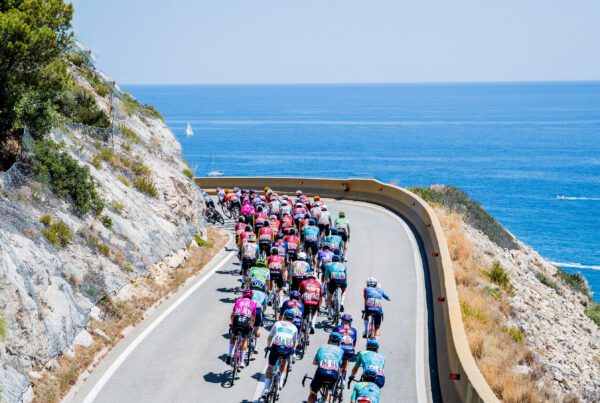
Most beginner cyclocross racers make the key mistake of practicing skills like barriers or remounts over and over again to perfect them, but ignore improving their cornering skills. But a cyclocross course may only have two places to remount, while it has literally hundreds of corners per lap. Road riding is similar: Riders focus on things like climbing better, but the reality is that cornering smoothly is the skill that gives you the most bang for your buck. If you can sail around a turn without scrubbing too much speed, you save huge amounts of energy because you don’t need to push to speed back up. To work on your corners, focus on the apex of the turn, says Glassford. If you need to slow down, do so before the corner. Then, let off the brakes, think ‘outside inside outside’ as you go around it—keeping an eye out for oncoming traffic, of course—and look through the corner.
Practicing these simple skills makes it easier to keep up with the speedsters in your local cycling club—and the more you practice skills like these, the more confident you’ll feel on the bike. While you don’t need to be a speedy cyclist to enjoy a trip with inGamba—we welcome riders of all skill levels—simple tweaks like this that can add speed are worth honing.
All photos by James Startt