The Countdown Has Begun
In a matter of days I’ll pack my bags and head for Barcelona, where my 37th Tour de France will begin.
Thirty-seven.
Had you found me in the summer of 1990 and suggested that I would still be following this race more than three decades later, I would have laughed at the idea. At the time, I had just finished a thoroughly forgettable season of racing in France and stumbled into an opportunity with a small tour company. It came with a Tour accreditation and the chance to write a few stories. Nothing more.
Or so I thought.
I came back the next year. Then the year after that. Somewhere along the way, the Tour stopped being an event on the calendar and became part of the architecture of my life.
Since then, July has never required much planning. I always knew where I would be.

The Tour has a gravitational pull that is difficult to explain to anyone who hasn’t experienced it. Every year it draws together cyclists, journalists, mechanics, roadside picnickers, retired champions, local mayors, and curious tourists into one sprawling, sun-drenched caravan that circles France like a traveling theater.
The racing is part of the attraction, of course, but I think of it more as France’s great annual road trip.
Jean-Marie Rivière — a close friend of former race director Jacques Goddet — once described the Tour as one of the world’s great spectacles, a work of Shakespeare complete with comedy, triumph, heartbreak, and tragedy. He wasn’t wrong. Every July, heroes emerge, ambitions collapse, and fortunes change in the space of a mountain pass or a crosswind.
But what has always captivated me is everything that happens beyond the race itself.
The Tour de France is, quite literally, a tour of France.
No event reveals the country quite like it.
For three weeks the Tour races through cities, forgotten villages, vineyards, mountain passes, medieval fortresses, and vast fields of sunflowers. The helicopter images are beautiful, but they never quite capture the feeling of arriving somewhere before dawn and watching a town slowly transform itself into a stage set.
That transformation is part of the magic.

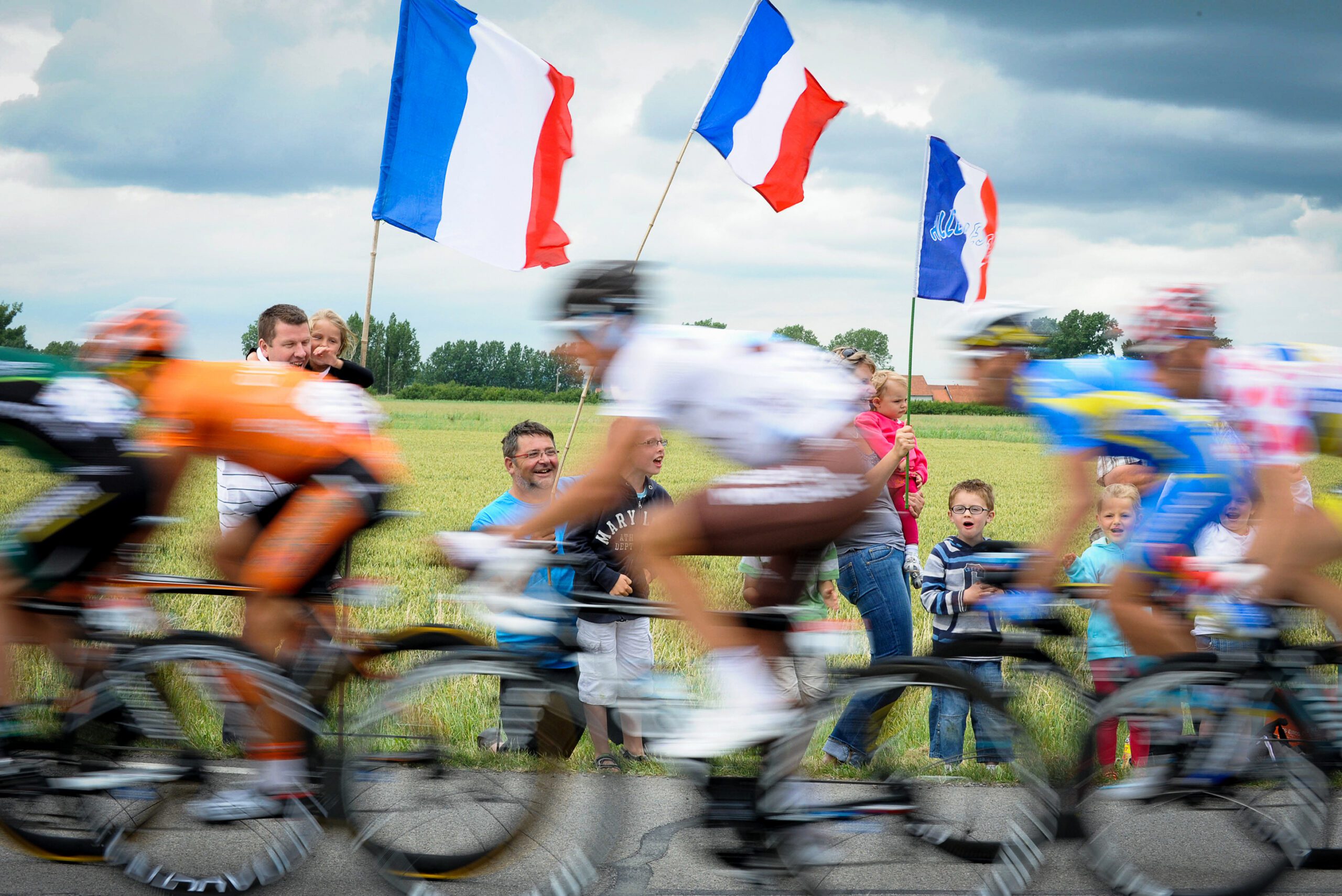
The French understand summer in a way few cultures do. Vacation is not an indulgence here; it is practically a civic institution. Entire families migrate to the roadside carrying folding chairs, baguettes, coolers, and enough patience to wait six hours for something that will pass in six seconds.
Much of the Tour’s popular success goes back to the 1930s, when France’s first paid vacations were introduced by Léon Blum, the left-wing head of government. It was a fact that Jean-Marie Leblanc, another former race director, often pointed out. Never mind that Leblanc was a classic conservative; he understood that such vacations were central to the Tour’s popular success. Today it simply feels French.
This year, there are a few stage locations on the calendar I’m particularly looking forward to.
Barcelona
This year, the adventure begins in Barcelona.
The Tour has visited the city before, but hosting a Grand Départ is something altogether different. Ever since the organizers announced the start, I knew I wanted to be there.
Barcelona has always possessed a certain theatricality. The city seems designed for spectacle, and a team time trial threading through its streets may feel less like a bike race and more like performance art.
As a photographer, I will spend the days before the start searching out the best spots to position myself. The real challenge won’t be finding beautiful backdrops. Barcelona is overflowing with them. The challenge will be choosing among them.
My thoughts keep returning to Antoni Gaudí’s Sagrada Família.
For generations, it existed in a permanent state of becoming, cranes hovering above the skyline like punctuation marks. Now, after more than a century of construction, it finally stands complete. Only last month, the Pope visited, and in a matter of days, the Tour will sweep past this masterpiece of Catalan modernism, adding another layer to the strange accumulation of history that follows this race wherever it goes.
The crowds will be enormous. They always are.
Still, I’m hoping to find a balcony, a rooftop, a forgotten window — some small perch above the noise from which to watch the world’s biggest bike race flow beneath one of the world’s most extraordinary buildings.
Moments like that are why I keep coming back.
Carcassonne
Yet as exciting as Barcelona will be, the places I most look forward to are often the ones I’ve visited many times before.
Take Carcassonne.
Long before the race arrives, the city’s medieval ramparts can be seen on the horizon. Rising above the surrounding countryside, they appear almost unreal, as though lifted from imagination — but its history is very real, rooted in the years of the Cathars, who called Carcassonne home.
Every Tour seems to generate its own collection of stories there. Some involve racing. Others involve wine. Most involve friends.
I’ve lost count of the evenings spent inside those ancient walls, sharing cassoulet from the nearby town of Castelnaudary with colleagues as daylight fades over the arid Languedoc countryside. There is a rhythm to those meals that feels inseparable from the Tour itself: long conversations, generous servings of the local wine, and stories retold for the hundredth time that somehow improve with age.
One memory stands above the rest.
In 2021, Mark Cavendish won his 34th Tour stage, equaling Eddy Merckx’s long-standing record. When he crossed the line, exhausted and overwhelmed, he collapsed just behind where I was standing. Instinct took over. I made the photograph.
A few hours later, I was informed that my enthusiasm had earned me a three-day suspension from the finish line, as I had broken rank with the protocol of the day.
It was a frustrating moment, to say the least — but one that was easily forgotten over that evening’s cassoulet.

Pau
Then there is Pau.
Every Tour journalist has a favorite town. Pau is mine.
It occupies a unique place in Tour history. Nestled against the foothills of the Pyrenees, it has become one of the race’s most dependable hosts, and it comes as no surprise that, after Paris and Bordeaux, it is the town most visited by the Tour. Riders arrive there. Rest there. Depart from there. The race seems perpetually drawn back to it.
So am I.
I have often driven hours out of my way simply to spend an extra night in Pau.
Part of the attraction is practical. There are hotels. Restaurants. Familiar faces.
But that’s not the real reason.
The real reason is that Pau understands the Tour.
The race settles into the city with remarkable ease. Journalists, mechanics, race officials, former riders, and members of the publicity caravan all seem to converge in the same places once evening arrives. Conversations spill from restaurants onto sidewalks. Rumors circulate. Friendships are renewed.
If you’re looking for me in Pau, there is a good chance you’ll find me at Le Berry. And if not there, well then, try the O’Gascon. Get the picture?
Bordeaux
Bordeaux, where the Tour will finish Stage 7, is another much-anticipated destination.
Second only to Paris in the number of stages hosted, the journey to France’s great wine capital was for many years the most coveted stage for sprinters. It has lost some of its luster in recent years and may soon be surpassed by Pau, as the Tour now visits only infrequently.
While there are plenty of hotels to accommodate the Tour entourage, they are far more spread out than in Pau, and chance encounters with colleagues from the race are not nearly as common.

La France Profonde
The Tour’s most memorable destinations, however, are often the places that rarely appear in guidebooks.
The French have a phrase: la France profonde. Deep France.
It is the France of small towns, quiet roads, church squares, local markets, and landscapes that seem untouched by urgency. Every summer, the Tour passes through communities that spend months preparing for a visit that lasts only minutes.
Yellow bicycles appear on rooftops. Polka dots are painted onto barns and yellow jerseys are draped over hay bales. Entire villages decorate themselves for the simple joy of being included in the race’s story.
Driving ahead of the Tour route remains one of my favorite rituals. It is impossible to know what awaits around the next corner. Sometimes it is a decorated village square. Sometimes it is a roadside celebration. Occasionally it is a local resident insisting that you sample a regional specialty — or a glass of wine. Refusing feels impolite.
This year the route returns to places like Périgueux and Bergerac, towns whose reputations rest as much on gastronomy as geography. They are places where conversations inevitably drift toward food, wine, and the proper preparation of foie gras.
Elsewhere, the Tour ventures into towns unfamiliar even to many Tour veterans — towns like Malemort and Ussel are newcomers, so I will be curious to discover them. That, too, is part of its enduring appeal.
After thirty-six previous editions, the race still finds ways to surprise me.
Chalon-sur-Saône
One of this year’s more intriguing stops is Chalon-sur-Saône.
For photographers, the town occupies near-sacred ground. Nearby, Nicéphore Niépce created what many regard as the world’s first photograph from the window of his studio in 1827. Every photographer who visits inevitably reflects on that fact. After all, we spend our lives chasing fleeting moments. Niépce managed to preserve the first one.
But really, the Tour itself isn’t so different.
For three weeks every summer, we attempt to freeze moments that would otherwise disappear. A rider’s expression. A mountain shadow. A roadside celebration, or a fleeting gesture that exists for only a fraction of a second. Photography and the Tour share an obsession with time. Perhaps that is why they feel so naturally connected.

The Alps
Eventually, as it always does, the race arrives in the Alps.
The Alps do not simply host the Tour. They dominate it.
The mountains possess a scale that overwhelms everything around them. Television struggles to convey their enormity. Photographs help, but even they fall short. You need to stand beneath them to understand.
Cycling belongs here. Sure, the climbs are challenging, but the rewards are bigger than life, as every summit offers another impossible view.
And then there is Alpe d’Huez.
Few places in cycling carry such mythology. The names are woven into the mountain’s history since a certain Fausto Coppi won the inaugural stage here in 1952, only to be followed by greats like Bernard Hinault, Andy Hampsten, and Marco Pantani. Its legendary 21 switchbacks are not unlike the cobbles of Paris-Roubaix. They are every rider’s dream.
The climb remains as compelling today as it was decades ago because it distills the Tour into its simplest form: one road, one mountain, and the struggle between ambition and gravity.
This year Alpe d’Huez once again takes center stage with not one but two stage finishes before returning to Paris.
I suspect it always will.

That is the beauty of the Tour.
For all its changes, certain places endure.
Barcelona will create new memories. Carcassonne will revive old ones. Pau will feel comfortingly familiar. Small villages will celebrate their moment in the spotlight. The Alps will remind us why cycling has always been drawn to mountains.
And somewhere along the way, another collection of moments will quietly join the thousands that have accumulated over the last thirty-seven summers.
That, more than anything, is why I keep coming back. The Tour is not merely a race. It is a movie of memories.