
Paris-Roubaix is without a doubt one of the world’s most explosive and dramatic events in cycling, as both the men and women race over the brutal cobblestone roads of northern France. But behind every “Hell of the North,” a small group of volunteers works quietly, month after month, to maintain the many sectors of cobbles. They are Les Amis de Paris-Roubaix, or the friends of Paris-Roubaix.

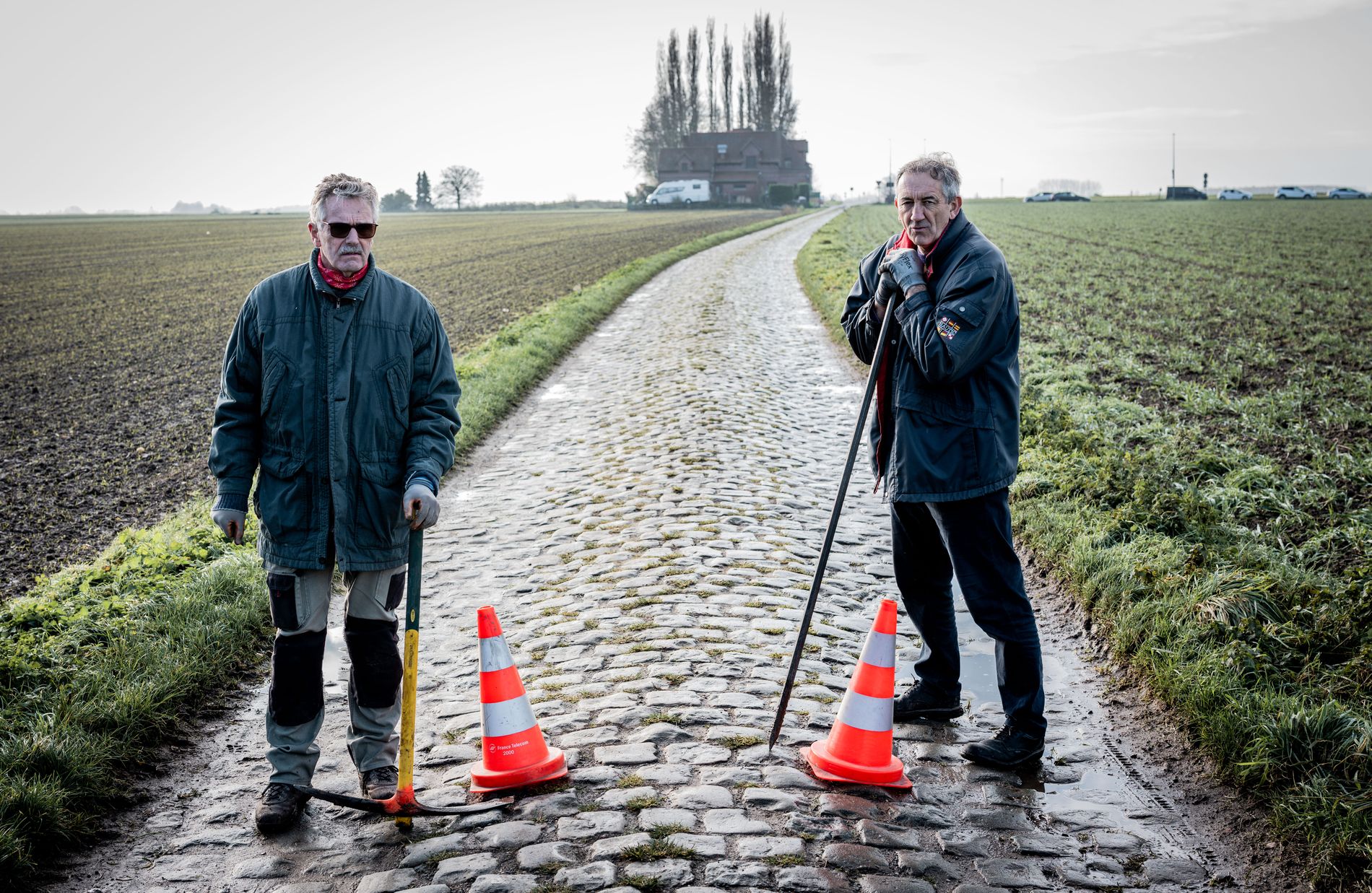
At the core of this association are les paveurs, about 20 of them. They are the men and women who work the cobbles. In many ways, they are the last of their kind. But they are also the soul of Paris-Roubaix.
Back in the 19th and early 20th century, les paveurs were essentially road workers. But as the pavé—cobblestones—slowly disappeared from the roads of France, so did les paveurs. But Les Amis, keep the tradition alive.
“Les Amis de Paris-Roubaix was formed at the end of the 1980s by a group of us that were concerned by the lack of cobblestone sectors remaining in this part of the country, and the state that they were in,” says Pascal Sergent, the current president of the group. “Our mission was to work on cobble sectors that still remained, and also to work with the local communities to educate them on how fragile they actually were. The cobblestones are really part of our patronage here and they needed to be saved.”

At face value, these cobbled roads are timeless, dating back centuries. But they are also ever-changing. And without the support of Les Amis, they would simply continue to deteriorate. “You know when these roads were built, the farmers here were still using horse and wagons to transport their produce,” says Jean-Guy Sapin, one of the core volunteers. “But the machinery, the tractors and trucks, just get bigger and heavier.”
Bettraves, or French beets, have long been a staple in this corner of France and the annual harvest is always problematic for the caretakers of the cobbles. It occurs in the autumn, a time of heavy rains, which soak into the cobbles, leaving the soil underneath moist, unstable, and vulnerable when the tractors roll over carrying the piles of beets stacked at the edges of the fields.

It’s a relatively mild day in November, when we visit the Carrefour de l’Arbe, the iconic sector of cobbles just a few kilometers from Roubaix. For the racers, it is one of the most challenging sectors of cobbles, and it is often considered the final opportunity for a rider to break free. But it is perhaps equally challenging for the paveurs, as it is one of the longest, most exposed sectors, ever so vulnerable to the weather conditions. Walking down from the historic café restaurant that sits at the end of the sector, the paveurs quickly identify a small area submerged under a pool of water from the recent rains.”
“This is the start of a big problem. You see, water amasses like this when the cobbles have been pounded down, and suddenly it becomes very uneven,” says Eric Dubois, the lead paveur of this group today. “And it will only get worse. So, the first thing we need to do is to evacuate the water.”

To do this, the group cuts through the small embankment on the edge of the road, before sweeping the water out into the ditch. Once the water is removed, they then proceed to dig each cobble out of its placement, before repacking the surface below with fresh sand and dirt that provides a more even, sturdy base layer for the cobbles. And then finally, they reposition the cobbles so that they are even.
In many ways theirs is a thankless job. Each cobble weights between 15 to 20 kilograms and much of their time is spent working on their knees along these uneven surfaces. But no one here is complaining. “We love this!” says Sapin, who also is quick to point out that the friendships formed working on these roads also plays a role in bringing them back day after day.

But their work does not go unnoticed. John Degenkolb, a former winner, made a 10,000 Euros donation just a few years back to help them meet their budget, and they are in regular contact with the race organizer A.S.O., who relies on Les Amis for updates on the evolution of the different sectors, especially in the harsh winter months and as the race approaches each spring.
With their first section repaired, they decide to break for lunch at a local friterie in Cysoing, the town closest to the Carrefour de l’Arbre. It’s been a good morning they all agree, and they toast over beer, while waiting for their meals. Les Amis de Paris-Roubaix, may well have been founded because of a bike race. But it is also, very much about friends.
THE FULL STORY IS COMING IN THE MAGAZINE SOON