
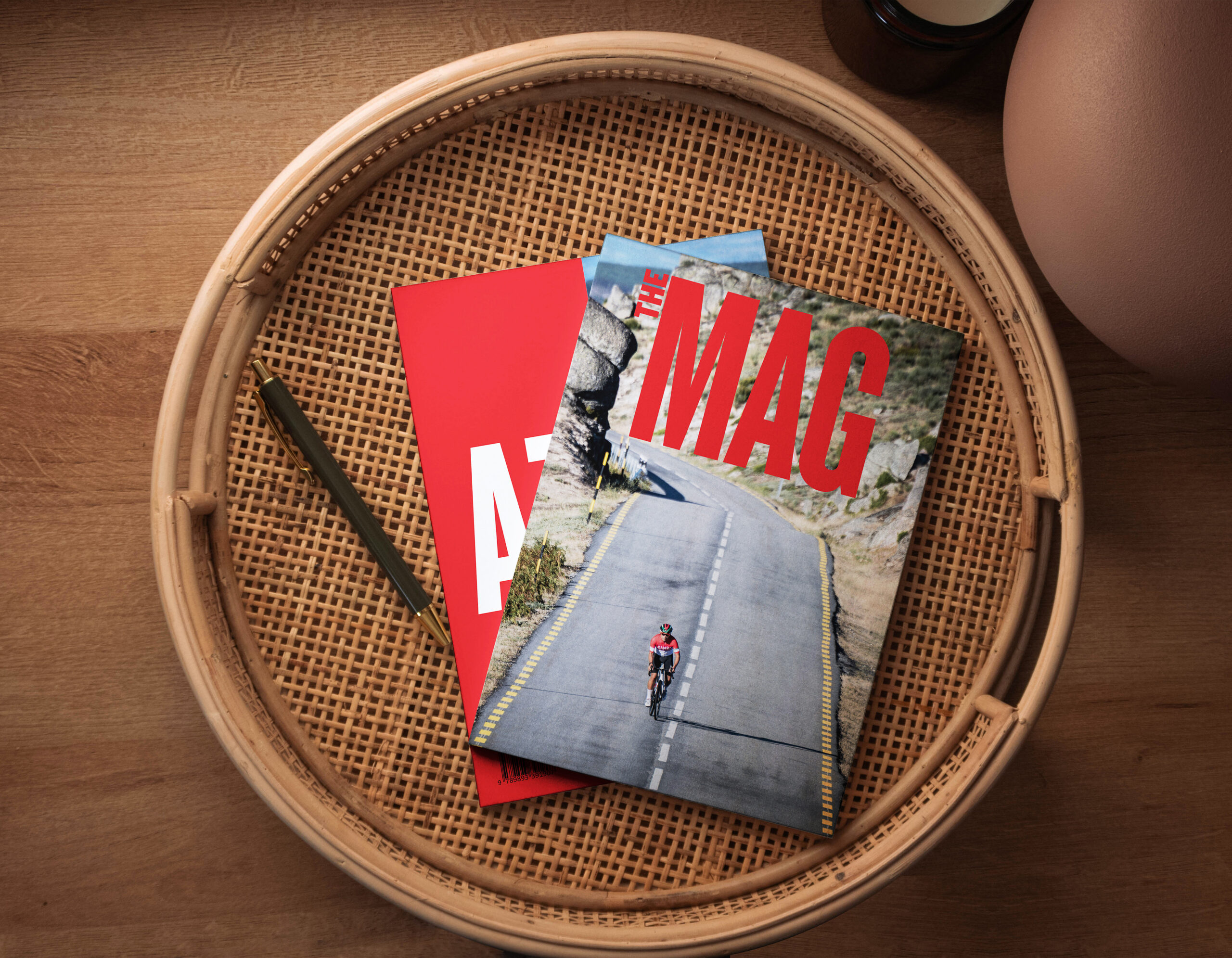
An open letter from James Startt, Editor of the Magazine and Creative Director of inGamba.
This edition of the Magazine is on its way to guests.
For the past 35 years, I have had the pleasure of working with many of the world’s best cycling publications as a photographer and writer. But until now, I was always that guy in the field—the reporter at large. This issue of inGamba: The Magazine marks the first time I have found myself on the opposite side of the editing desk, overseeing the production of the entire publication. It was an eye-opening experience in many ways, but also a hugely satisfying one, as I helped choose every image and shape every page of the magazine.
My objective—or perhaps I should say my mission—was simple: to celebrate the history and culture of this magnificent sport through the eyes of inGamba. And in doing so, to produce a magazine as beautiful as any I have ever worked on. Along the way, it gave me the pleasure of working with some of my favorite writers and illustrators. Weeks turned into months as I worked with our art director, David Sereno, to sculpt every page of the magazine. And as I look back over these 144 pages, I can say without a doubt: mission accomplished.
As part of the inGamba family, you most likely know our Mangia, Beve, Bici motto, and I used these three themes to structure, at least loosely, the different sections of the magazine.
What better way to start the Mangia section than with a feature on the art of eating? The piece was written by longtime inGamba collaborator Colin O’Brien and illustrated by my friend Tommaso Montagnani, and it quickly became one of my favorite features in the magazine. At inGamba, the dining table is central to our experience, but Colin maintains that anytime is a good time for a good meal, and he writes about the art of eating alone. Reading the piece, you instantly understand the rigor of Colin’s writing, and Tommaso’s illustrations could not be more fitting.
Colin’s feature is followed by that of Barry Ryan. Interestingly, Barry, like Colin, is also Irish, and between the two of them, they honor the great tradition of Irish writers in their own unique ways. Barry, who holds a doctorate in Italian Renaissance literature, writes about the cultural and cycling history of the city of Siena, a town close to the heart of inGamba, as it lies only a few kilometers from Borgolecchi, our home in the heart of Tuscany. From the moment I took on the task of editing the magazine, I knew I wanted to work with Barry, and that he would be the perfect person to weave together Siena’s rich history—bringing together the likes of Dante’s Divine Comedy with, say, Strade Bianche. He does just that, and much more.
The next feature is one I have long wanted to do, with Adrie van der Poel and his wife Corinne. Adrie, of course, is a cycling legend in his own right, while Corinne is the daughter of the great French champion Raymond Poulidor. Together, they are the parents of a certain Mathieu van der Poel. Between them, they bring more than 60 years and three generations of cycling. And I was not disappointed. Driving up to their home on the Belgian-Dutch border, I enjoyed a day well spent with the couple—not to mention their two magnificent Dalmatians—discussing the past, present, and future of the sport. (The Dalmatians didn’t have much to add to the conversation, but they were undeniably charming.)
The Beve section opens with a visit to the Azores, in a guest piece written by Ned Creed. Ned had wanted to join an inGamba trip for years and finally did so in 2025. These Portuguese islands offered him the ultimate experience. And while it may have been his first trip, he instantly understood the inGamba ethos, spending as much time writing about the cycling as he did the food and drink found in this unique corner of the world.
The following feature looks at one of my favorite subjects: cycling and art. It is safe to say that few people grow up dreaming of becoming a cycling journalist, and I was no exception. Before moving to Europe, I completed a master’s degree in art history. This piece, focusing on the connection between Cubism, Futurism, and the bicycle, allows me to bring together two of my lifelong passions, while also exploring how artists from these movements incorporated the bicycle into their work.
Perhaps due to my background in art history, I have long been drawn to photographing cycling landscapes. In my early years covering the sport, I focused on the intensity of racing action. But in recent years, I have enjoyed stepping back and capturing the sport as landscape. Simply put, cycling takes us to extraordinary places. The scenery is constantly changing, but one thing is certain: a bike race has a unique way of igniting any landscape it crosses. This feature brings together many of my landscape photographs.
Our final section is Bici, and we open it with another piece by one of my favorite writers, Bill Strickland. Bill was my longtime editor at Bicycling Magazine and remains a close friend of both me and inGamba founder João Correia. Asking him to contribute felt only natural. I love Bill’s writing; he has a singular way of capturing the sensations of riding. His piece, titled “The Flow,” does exactly that, while the illustrations of inGamba art director David Sereno bring the words to life in an equally original way.
The Bici section would not be complete, however, without features on professional riders, and the next piece focuses on one of my all-time favorites, Geraint Thomas. For this feature, I asked Ed Pickering—another friend and former editor—to collaborate. Thomas is one of the sport’s most unassuming champions, which is precisely why I admire him so much. Ed, who began interviewing him before he even turned professional, was the perfect person to write this piece. My thanks to him.
For those intrigued by performance, inGamba writer Molly Hurford breaks down one of the sport’s key questions: the delicate balance of a cyclist’s power-to-weight ratio. You don’t have to be a professional to care about this often elusive metric, and Molly explains it in terms any cyclist can understand. Meanwhile, Alexandre Coutelis, a well-known French illustrator, created three uniquely striking images to bring the piece to life.
From the science of sport, we shift to a feature focused on artisans, visiting Rute Vieira and her partner José Lima, founders of Ideal & Co. While the brand may not yet be a household name, anyone who has been on an inGamba trip will recognize their work: they create the handmade day bags provided to each guest. Founded in 2012, they continue Vieira’s family tradition of crafting vegetable-tanned leather goods.
From Ideal & Co.’s workshop in Porto, we travel to northern France to meet a different group of artisans altogether: les paveurs, who maintain the cobbled sectors of Paris-Roubaix. Known as Les Amis de Paris-Roubaix—the Friends of Paris-Roubaix—this small group of volunteers works quietly, month after month, to preserve these iconic roads. In many ways, they are the heart and soul of this race, known as the Hell of the North.
To close this issue of inGamba: The Magazine, we look to the future with a feature on up-and-coming rider Franzi Koch. If you watched the Tour de France Femmes last year, you saw her constantly on the attack. But that was only a glimpse of what was to come. This year she has not only finished in the top ten of nearly every classic, but her stunning victory in Paris-Roubaix Femmes has catapulted her to the forefront of the sport.
And with that, the 2026 issue of The Magazine comes to a close, save for a final selection of images and a quote from the great Eddy Merckx. Now I can only wait—impatiently—to hold it in my hands and finally turn these pages in print. And I can only hope you enjoy reading it as much as I did creating it.
Thanks for reading, and being part of our community.
James
A special thanks to contributers: Ned Creed, Colin O’Brien, Bill Strickland, Edward Pickering, Annavitte Rand, Barry Ryan, Alexandre Coutelis, Tommaso Montagnani, David Sereno and the Shoreditch Sketcher.