
When the Tour de France is in full swing, the spotlight naturally falls on the riders. But behind every stage winner is an army of mechanics, soigneurs, and technical staff working long before the peloton rolls out each morning. Among them is SRAM’s race support team, whose job is to keep nearly half the Tour de France peloton shifting flawlessly through three weeks of racing.
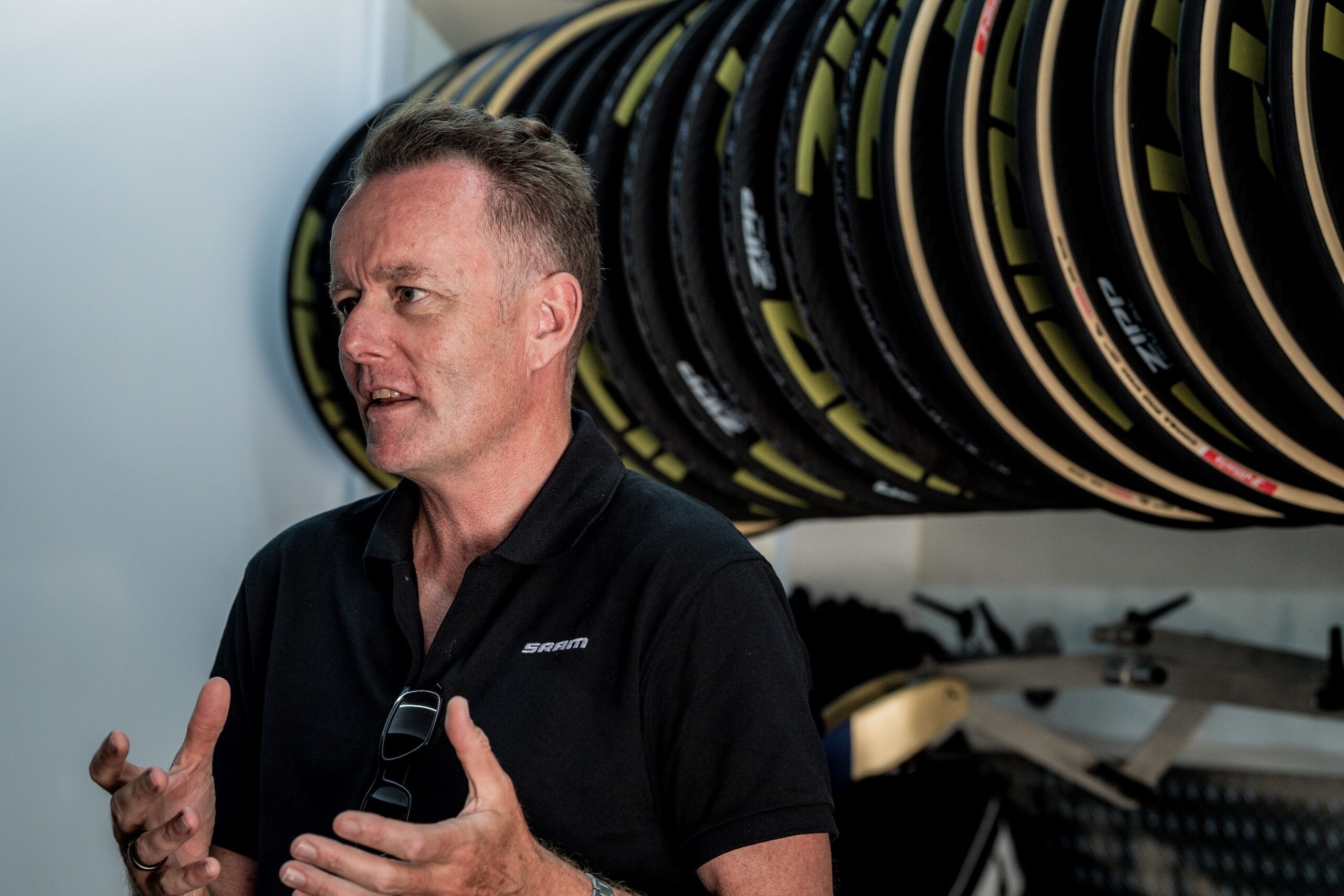
Leading that effort is Jason Phillips, SRAM’s Race Manager for Road, whose connection to the sport stretches back well before he joined the company.

“I was a professional rider until the end of 2007,” Phillips says. “I came straight to SRAM after my career. I actually raced one of the first SRAM Force groupsets.”
Nearly two decades later, Phillips oversees SRAM’s support for every WorldTour and ProTeam using the company’s components, as well as its athletes in gravel, cyclocross, and triathlon.
“I have my own team of race technicians who are at all the races, working with the team mechanics and training them on our products,” he explains. “Each of our teams has a designated race tech who becomes their point of contact whenever they need product or have an issue.”
The work begins long before the first race of the season. SRAM technicians are on hand as teams build new bikes during the winter, ensuring mechanics are fully trained on the latest equipment. From December training camps to the Tour Down Under, the Spring Classics, the Giro d’Italia, and finally the Tour de France, SRAM’s technicians travel virtually year-round. “That is the heart of our season,” says Philips.
The company’s presence at the Tour has grown dramatically. After supporting five teams in last year’s race, SRAM has doubled that number in 2026, providing technical support to ten teams, including Red Bull-BORA-hansgrohe, Team Visma – Lease a Bike, Lidl-Trek, Movistar, EF Education-EasyPost, Tudor Pro Cycling, Q36.5 Pro Cycling, Uno-X Mobility, and others.
That growth mirrors the evolution of SRAM itself.
“When I first started, our groupset was by far the lightest on the market—maybe even a little too light,” Phillips says with a laugh. “There was a lot more service needed then, and I was pretty much the only contact for the teams. But we’ve developed enormously since those days.”

Much of that development has come directly from the demands of professional racing.
“One of the biggest game changers for us was partnering with Visma,” he says. “That first year was essentially one long testing and development program. Those guys are absolutely at the pinnacle of marginal gains—they really pushed us. Lidl-Trek has always given us tremendous feedback, and today Red Bull is another incredibly data-driven team that’s constantly pushing us to improve.”
For Phillips, the relationship between manufacturer and team is far more collaborative than many fans realize.
“We have regular technical meetings with every team,” he says. “Some of those conversations are about equipment needs, but a lot of them are about feedback—feedback that we can use. The work we’ve done with our teams is why our products get better with every generation.”
The Tour also marks a milestone for the Pinarello-Q36.5 team, making its debut in cycling’s biggest race after several years of steady growth. SRAM has been part of that journey from the beginning.
“We’ve been with this team since they started, so we’re really happy to see them progress to the Tour de France,” Phillips says. “Officially they’re still a ProTeam, but when you look at the organization, the riders, and the way they’re racing, they’re operating at a WorldTour level. I’ve known Doug Ryder since we raced together, and it’s just a great team to be around.”
That long-standing relationship is equally valued by Q36.5 founder Douglas Ryder.
“Our relationship with SRAM goes way back to when Jason and I raced together,” Ryder says. “Then through the Qhubeka team in Africa, and now again with this team, Jason has always been there for us. He’s an incredibly committed and hard-working guy who has always fought for us. Through his leadership and the team he has on the ground, we’re incredibly well supported by SRAM.”
For all the cutting-edge technology on display at the Tour, one principle remains unchanged. Every product developed and refined under the pressure of professional racing must eventually be available to everyday cyclists. The Tour may be cycling’s greatest laboratory, but its innovations are ultimately destined for riders far beyond the Champs-Élysées.
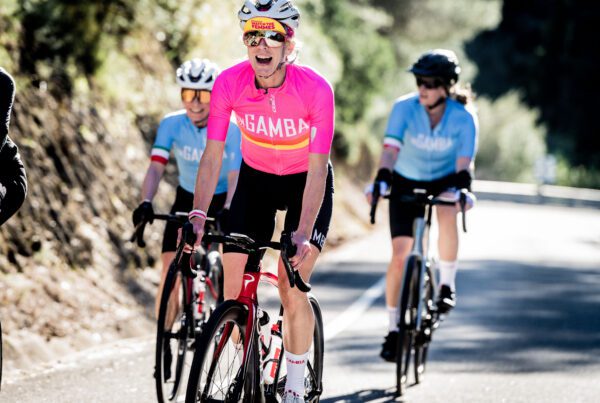
As a result, the same SRAM components being pushed to their limits at the Tour de France are the very same found on the bikes ridden by guests of inGamba. It’s a direct link between the world’s biggest bike race and the roads explored by passionate amateurs, allowing riders to experience equipment that has been refined through thousands of kilometers of racing at the sport’s highest level.